Bat Box Occupancy Survey
Which bat boxes have been proven to be used by colonies of bats in the UK?
Flight Ecology are compiling data for the use of bat boxes by colonies of bats in the UK. After carrying out some research into suitable boxes to use as mitigation for a impacts to a small maternity roost, it became apparent that little evidence exists for which boxes are used by bat colonies. This makes it difficult to select appropriate boxes for projects when you are aiming to target certain species.
Flight Ecology subsequently set up a database for records of bats in bat boxes. For the purposes of the project, 'Colonial' occupancy was defined as more than five bats. Those records of four or less bats within a box were therefore discounted. To submit a record of a colony of bats within a bat box, please head to our records page here. The survey form is designed to be quick and simple, so that we can obtain as many records as possible. However, if you have multiple records of bat occupancy that you would like to submit then please download the form here and email it to us.
Results So Far
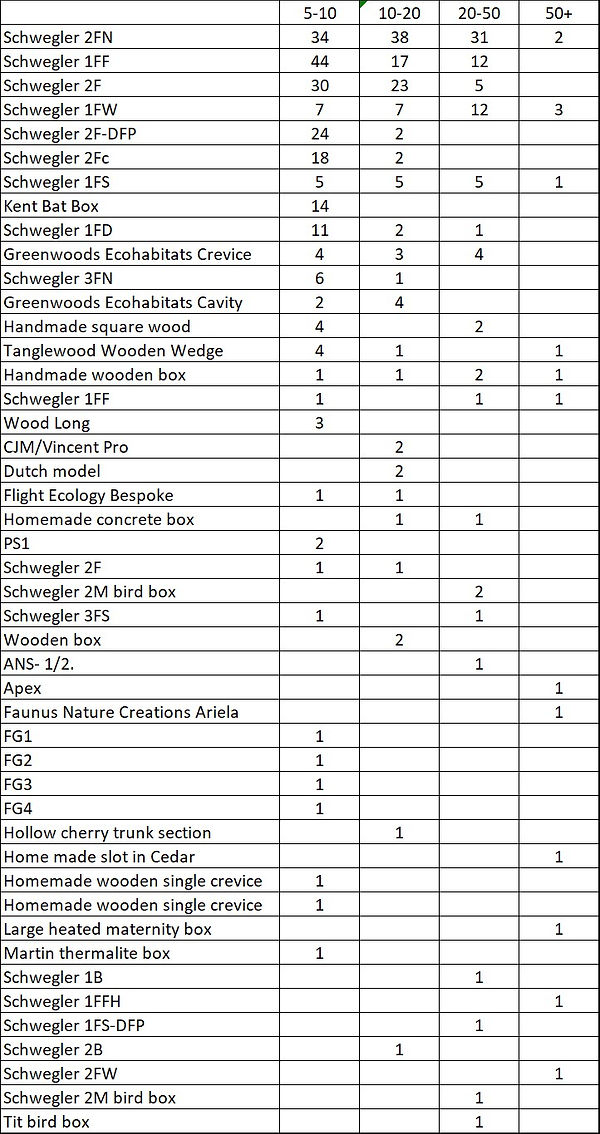
To date, we have almost 450 records of colonies of bats in bat boxes. We will make the complete database available in due course, but in the meantime we have uploaded some graphs of the results below.
The main take home messages are that not all box types appear to support colonies of bats. The box with the most records of bat colonies was the Schwegler 2FN, followed by the Schwegler 1FF and the Schwegler 2F. These are some of the most commonly used boxes in the UK, and therefore there are likely to be more records for these boxes. However, even despite this, these boxes are clearly a good option for bat colonies, with 9 species being found in the 1FF, 8 in the 2F and 6 in the 2FN. Several other Schwegler boxes also have good numbers of colonial bat records, including the 1FW (28 records), 2F-DFP (26), 2FC (20), 1FS (16) and 1FD (14).
Of the non-Schwegler boxes, the Kent Bat Box, a wooden crevice box that is commonly home-constructed, and the Greenwoods Ecohabitats Crevice box, a combination of concrete and polystyrene, both have good numbers of records, with 14 and 11 records respectively. The Greenwoods boxes, in particular, are less widely used than Schwegler boxes, and therefore are likely to have a proportionately high occupancy. Records indicate that both of these boxes are particularly well used by pipistrelle bats.
Below is a summary of which boxes have been shown to suit the different UK bat species. Current records show that soprano pipistrelles are the most catholic in their taste, using 26 different boxes. In comparison, common pipistrelles used just 9. There may be an element of misidentification here, but this is unlikely to account for such a large discrepancy. The two other 'generalist' species were the Natterer's, using 18 different boxes, and the brown long-eared, using 12.
On the more specialist end, there are just single records for Brandt's, whiskered, grey long-eared, and Nathusius pipistrelle, while Barbastelle were found in 2 types of boxes and Bechsteins were found in 3. Naturally, some of these species are quite rare species and therefore records are likely to be sparse. Whiskered and Brandt's bats are likely under-recorded, potentially due to the difficulty in distinguishing them to species level and therefore a reluctance to submit the records.

These records are just the start. With more records comes more knowledge of how bats use different bat boxes. If you have any records of colonies (more than 5 bats) using any bat boxes, then please submit your records here, so that we can increase our data. We will update this page as we get more data.